Losing all of your teeth, or facing a situation where the teeth you have left cannot be saved, is one of the more significant health decisions a person can face. For decades, the standard solution was a removable denture. Today there is a better option. Full arch dental implants replace an entire upper or lower jaw with a fixed, permanent prosthesis anchored directly to the jawbone, giving patients the function, stability, and appearance of natural teeth without anything that comes in and out.
What Are Full Arch Dental Implants?
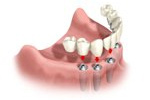
Full arch dental implants are a fixed dental restoration that replaces every tooth in the upper jaw, lower jaw, or both. Rather than resting on the gums like a traditional denture, the prosthesis is anchored to a series of titanium implants placed directly into the jawbone. The implants fuse with the bone through a process called osseointegration, creating a stable foundation that functions the way natural tooth roots do. The prosthesis does not move, does not require adhesive, and does not need to be removed for cleaning.
At Bend Oral, Facial and Implant Surgery, our full arch replacement procedures are performed by Dr. DeLisi, a board-certified oral and maxillofacial surgeon who has served Central Oregon since 2008. Full arch implant surgery is a technically demanding procedure, and the experience of your surgeon matters significantly to the outcome.
How the Procedure Works
The full arch implant process involves several stages that unfold over a period of months, depending on bone density, whether any remaining teeth need extraction, and whether preparatory procedures like bone grafting are required.
The process begins with a thorough evaluation using advanced cone beam imaging to assess bone quality and volume and to plan precise implant positioning. This planning phase is critical. Implants placed in the wrong position or at the wrong angle can compromise the final result, which is why precision imaging and an experienced surgeon are both essential. Most full arch cases use four to six implants per arch, strategically positioned to maximize bone contact and provide even support for the final bridge.
Temporary teeth are attached at or shortly after surgery so you can eat and function normally while the bone integrates with the implants, a process that typically takes several months. Once osseointegration is complete, the permanent bridge is custom-fabricated and attached. Most patients report the recovery was more manageable than anticipated. Swelling and soreness are normal in the first week or two, but the majority of patients return to routine activity within a few days and find eating and speaking with temporary teeth far more comfortable than they expected.
Full Arch Implants vs. Traditional Dentures
The most important distinction between full arch implants and traditional dentures is that implants are fixed. They do not shift when you eat, they do not require adhesive, and they do not need to come out at night. For most patients who have worn dentures, this difference is transformative.
There is also a biological dimension many patients do not know about. When teeth are lost, the jawbone beneath them begins to resorb because it is no longer being stimulated by chewing forces. Dentures do nothing to stop this process. Over time, bone loss changes the shape of the face and alters how a denture fits. Full arch implants, because they are anchored in the bone, provide the stimulation needed to preserve bone volume and maintain facial structure.
Research published in BMC Oral Health found that patients who received full arch implant-supported fixed prostheses reported significantly higher satisfaction with chewing ability, esthetic appearance, and overall oral function compared to conventional removable options.
Who Is a Good Candidate?
Full arch dental implants are appropriate for patients who are fully edentulous or whose remaining teeth cannot be saved. Candidates need sufficient jawbone volume and density to support the implants and adequate overall health for surgery. Some patients require bone grafting beforehand to rebuild the foundation. The need for grafting adds time to the process, but it is often the difference between being a candidate for implants and not being one.
Factors like uncontrolled diabetes, heavy smoking, certain medications, and a history of radiation therapy to the jaw are not automatic disqualifiers, but they need to be discussed during your evaluation. A thorough consultation with an experienced oral surgeon is always the right first step. Dr. DeLisi will review your imaging, assess your bone and tissue health, and give you an honest evaluation of your options and what the realistic path forward looks like.
You can learn more about preparatory procedures on our bone grafting page.
What the Research Shows
A large cohort study published in Clinical Oral Implants Research followed more than 10,000 dental implants over up to 22 years and found cumulative survival rates of 98.5 percent at five years and 96.8 percent at ten years. A systematic review also found that oral health-related quality of life improved significantly after full arch implant treatment, with patients reporting better chewing efficiency, esthetics, speech, and psychological wellbeing.
The key factors for long-term success are surgeon experience, accurate treatment planning, bone health at placement, and patient commitment to maintenance. When those conditions are met, full arch dental implants are among the most durable and reliable options in modern dentistry.
Why Choose Bend Oral Surgery
Dr. DeLisi is the most senior, experienced, and longest-tenured oral and maxillofacial surgeon east of the Cascades in Oregon, with over 15 years serving Central Oregon. Full arch cases require a surgeon who understands not just how to place implants, but how the entire restoration will function and look over time. His background spans both the surgical and prosthetic dimensions of complex implant cases, which means every decision from imaging through final placement is made with the complete picture in mind.
The practice offers advanced on-site cone beam CT imaging, thorough pre-surgical evaluation, and a treatment approach tailored to each patient’s anatomy and goals. Veterans and uninsured patients who pay out of pocket receive a five percent discount, reflecting the practice’s commitment to making quality surgical care accessible to the community it serves.
Take the Next Step
If you are living with missing teeth, struggling with dentures, or facing the loss of teeth that cannot be saved, full arch dental implants may be the most impactful decision you can make for your oral health. The outcomes are well documented and the quality of life improvement for most patients is significant.
Contact us today to schedule an appointment or learn more about our dental implant services in Bend, Oregon.